

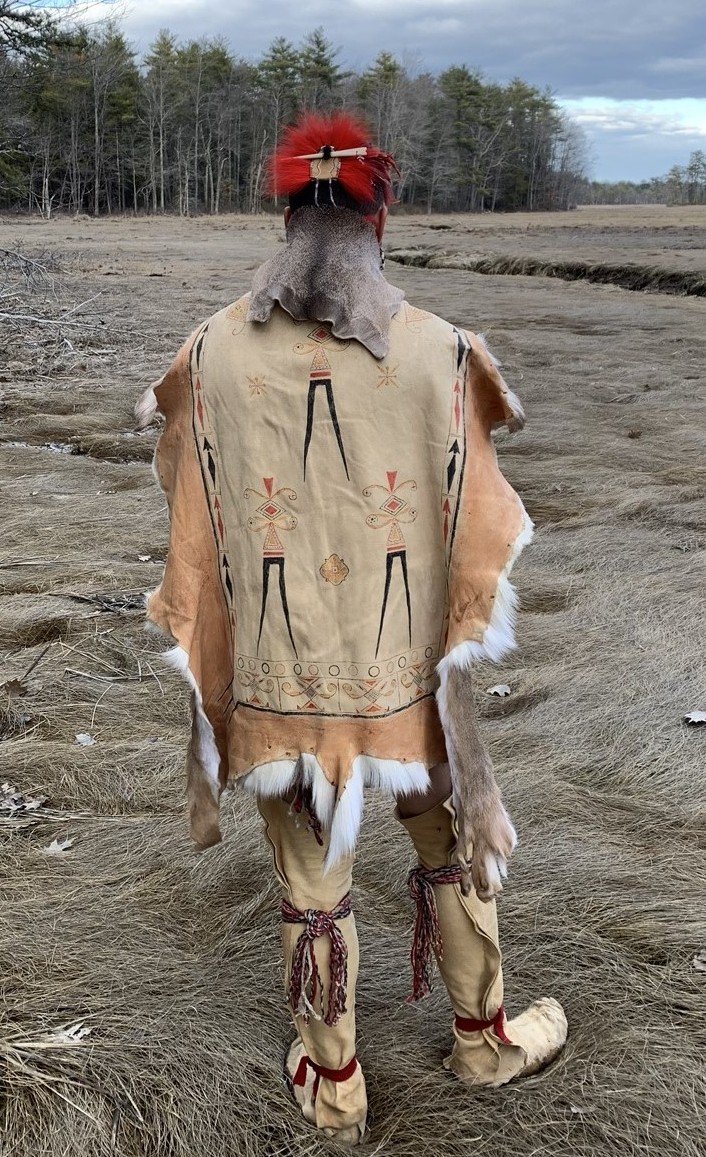
Dylan Smith, painted fur mantle, NAHC encyclopedia.
“A Pipeline of Trade”
Furs and the Early Fur Trade of the Algonkian Realm
(Drew Shuptar-Rayvis 2025/26)
https://encyclopedia.nahc-mapping.org/object/fur-fur-trade
Of the numerous things early European explorers observed when they began to traverse the ancient waterways and hinterlands of the Eastern Woodlands of North America, was the manner in which Indigenous people were dressed. The people were often described as wearing the skins of numerous animals as their cloaks, or mantles made from carefully woven turkey feathers.
To European explorers it was not just the exoticism of these strange people and their attire that was intriguing to them, it was the material the clothing was made from. In Europe, furs had always been of great value. Prior to Christianity, Indigenous Europeans held that the skins of certain animals such as boars, wolves, and bears were imbued with spiritual power. By the time of the little Ice Age (1300-1850 C.E), a period of intense freezing weather, furs became a luxury item desired to build warm clothing for the wealthy. Furs were needed for another popular and necessary article of clothing: hats. Hats can be made in two ways, either from woolen felt which takes raw wool and through a process of boiling, chemicals and other methods creates an interlocking fiber that can mat together to form a thick and flexible fabric or, fur felt which can be made using the same process but using the thick, oily under hair of fur bearing mammals such as minks, beavers, otters and muskrats. This fur felt, made from oily under hair is the most prized for its stiffness, shape retention, weight, and quality. A cheaper version of fur felt can also be made using rabbit fur.
Hats in the seventeenth century, particularly large, wide-brimmed black hats made in the Dutch or English “cavalier style” denoted wealth, prestige, and were the height of fashion. No gentleman or man of reputation could leave his home without a black hat of either style in the seventeenth century. The rise in popularity of these hats increased demand, which turned enterprising Dutch eyes away from the North Sea and the expensive Scandinavian and Slavic imports at the port of Oslo, to more lucrative, untapped and from the Dutch perspective “cheaper” markets across the sea in the dense forests of eastern North America.
Furs for Algonkian and Haudenosaunee people were a winter clothing staple. Furs from numerous animals such as bears, deer, beavers, and otters provided much needed warmth in the winter months and were worn by both men and women. Furs also provided excellent blankets and bedding for wigwam and longhouse living.
Of the earliest accounts of Algonkian people wearing furs, comes from the 1524 account of Giovanni da Verrazano (1485–1528) sailing on the behalf of Francis I of France (1494–1547), in search of a northwest passage to Asia. Verrazano describes native people and their dress in what was believed to be Newport Harbor, Rhode Island, “Among them were two kings more beautiful in form and stature than can possibly be described; one was about forty years old, the other about twenty-four, and they were dressed in the following manner. The oldest had a deer's skin around his body, artificially wrought in damask figures, his head was without covering, his hair was tied back in various knots; around his neck he wore a large chain ornamented with many stones of different colors. The young man was similar in his general appearance. This is the finest looking tribe, and the handsomest in their costume: that we have found in our voyage.” Verrazano continues, “Their women are of the same form and beauty, very graceful, of fine countenances and pleasing appearance in manners and modesty; they wear no clothing except a deer skin, ornamented like those worn by the men; some wear very rich lynx skins upon their arms, and various ornaments upon their heads, composed of braids of hair, which also hang down upon their breasts on each side.” (1)
Corroborating Verrazano, the Dutch explorer, merchant and one time patroonship holder of Staten Island, David Pietersz De Vries (c. 1593–1655) said of Indian dress in 1650, “I will state something of the nations about Fort Amsterdam[the site of present day NYC]; as the Hackinsack, Taepense and Wickqueasackse Indians; and these are embraced within one, two, three and four miles of the entrance to the river.... Their clothing is a coat of beaver skins, over the body, with fur in the winter and outside in the summer; they have also sometimes a bear's hide or coat of skins of wild cats, or hefspannen [raccoons] they also wear coats of turkey feathers, which they know how to put together; but since our Netherlands Nation has traded here, they trade their beavers for duffels cloth, which we give for them, and which they find more suitable than beavers as they consider it better for rain… They make themselves shoes and stockings of deerskins and they take the leaves of maize (cornhusks) and braid them together to use for shoes.” (2)
One hundred years later, Moravian missionary Johannes Heckewelder (1743–1823), recounting the oral history of his mid- to late eighteenth-century Western Delaware (Lenape) congregants, says, “In ancient times, the dress of the Indians was made of the skins of animals and feathers. This clothing, they say, was not only warmer, but lasted much longer than any woollen goods they have since purchased of the white people. They can dress any skin, even that of the buffaloe, so that it becomes quite soft and supple, and a good buffaloe or bear skin blanket will serve them many years without wearing out. Beaver and raccoon skin blankets are also pli-ant, warm and durable; they sew together as many of those skins as is necessary, carefully setting the hair or fur all the same way, so that the blanket or covering be smooth, and the rain do not penetrate, but run off. In wearing these fur blankets, they are regulated by the weather; if it is cold and dry the fur is placed next the body, but in warm and wet weather, they have it outside. Some made themselves long frocks of fine fur, and the women's petticoats in the winter season were also made of them, otherwise of dressed deer skins, the same as their shirts, leggings and shoes. They say that shoes made of dressed bear skins, with the hair on and turned inside, are very warm, and in dry weather, durable. With the large rib bones of the elk and buffaloe they shaved the hair off the skins they dressed, and even now, they say that they can clean a skin as well with a well prepared rib-bone as with a knife. The blankets made from feathers were also warm and durable. They were the work of the women, particularly of the old, who delight in such work, and indeed, in any work which shews that they are able to do their parts and be useful to society. It requires great patience, being the most tedious kind of work I have ever seen them perform, yet they do it in a most ingenious manner. The feathers, generally those of the turkey and goose, are so curiously arranged and interwoven together with thread or twine, which they prepare from the rind or bark of the wild hemp and nettle that ingenuity and skill cannot be denied them. They show the same talent and much forethought in making their Happis, the bands with which they carry their bags and other burdens; they make these very strong and lasting.”(3)
These sources all prove that Indian dress in the Eastern Woodlands, though generally universal, was rich in furs, which European explorers, settlers and traders took notice of immediately. However, this desire for new furs caused problems. Europeans were more than happy to supply Native peoples with different trade goods for these pelts, these small goods sometimes described as “trinkets” or “small truck” could be anything from beads, knives, hawk bells, mirrors (glasses), Native American pipes as well as European clay tobacco pipes, awls, and axes.
Of these trade goods, one stands out, Duffel cloth, named after Duffel, a town near Antwerp in the Southern Netherlands (todays Belgium), where the fabric was first made. Sometimes also called Frieze or Dutch/Welsh Rugged Cloth, Duffel was a thick, coarse napped woolen cloth that was one of the earliest and most desired trade goods to come out of Europe. Often coming in either blue or red, other colors and color preferences are mentioned “The textiles that were shipped to New Netherland largely consisted of woolen cloth originating from Amsterdam, Leiden, and Kampen. Duffel, a coarse woolen cloth with a thick nap, was intended for the fur trade. The Indians used the duffel in a way unfamiliar to the Europeans, one that surprised Isaac de Rasière: "They also use a great deal of duffel cloth, which they buy from us, and which serves as their blanket by night and their dress by day." He had found that it was virtually impossible to sell red or green duffels, "because the wilden say that it hinders them in hunting, as it is visible from too far off. The Indians preferred black. Lead bale seals found many years later during excavations reveal that the cloth supplied to the Indians was of a high quality.” (4)
To meet the supply needed to keep the economy moving, Dutch traders needed massive amounts of furs from Indigenous hunters. Furs became so critical to the Dutch colony, that it used both wampum and beaver skins as de facto currencies when coin was not always available or useful, for in the early years we have no knowledge of coin being desirable to Indigenous peoples. Adriaen van der Donck, Schout of New Netherlands records, “We beg the reader to note that in New Netherland and adjacent districts, some eighty-thousand beavers are put down every year, that we, during the nine years we were there, often made a meal of beaver meat, also kept them from a young age, and handled many thousands of beaver skins.” (5)
As one may imagine from Van der Donck’s figures, the demand for beaver among Europeans was insatiable and Indians were willing to attempt to satiate them for trade goods. By the 1660’s the Atlantic seaboard beaver trade (which included other skins such as wild cats, raccoons, minks, muskrats, otters, bear skins, though the most desirable was beaver) was nearly wiped out. Farther north, the Haudenosaunee embroiled themselves in Beaver Wars (c. 1640–1701) to keep their pipeline of trade open. Needing to access beaver territory farther west as well, the Haudenosaunee were more than happy to make war on their enemies and hopefully subjugate them in order to more peaceably extract beaver furs from their territory.
Though never going away fully, by the 1660’s through to the 1690’s the Atlantic Seaboard beaver trade is a mere shadow of what it was in the 1630’s. This decimation of multiple keystone species had not only environmental effects but also societal impact. Now that there were much fewer beaver furs to trade for trade goods, which unfortunately Native American communities became increasingly dependent on, the only other option to acquire trade goods was the sale of precious tribal lands to European buyers. All of this in hopes of keeping the peace with the massive influx of settlers and to have enough goods to keep them going for another season.
- Ronald Dale Karr. Indian New England 1524-1674, A Compendium of Eyewitness Accounts of Native American Life (Branch Line Press, 1999), page 19-20.
- Julian Harris Salomon. Indians of the Lower Hudson Region: The Munsee (Historical Society of Rockland County, New York City, 1982), page 19.
- John Heckewelder. History, Manners and Customs Of The Indian Nations Who Once Inhabited Pennsylvania and Neighboring States (Ayer Company Publishers 2005), page 202-203.
- Jaap Jacobs. The Colony of New Netherland: A Dutch Settlement in Seventeenth-Century America (Cornell University Press, 2009), page 137.
- Adriaen Van Der Donck, A Description Of New Netherland, “Of the Dress and Ornaments of Men and Women” (University of Nebraska Press, 2008), page 117.