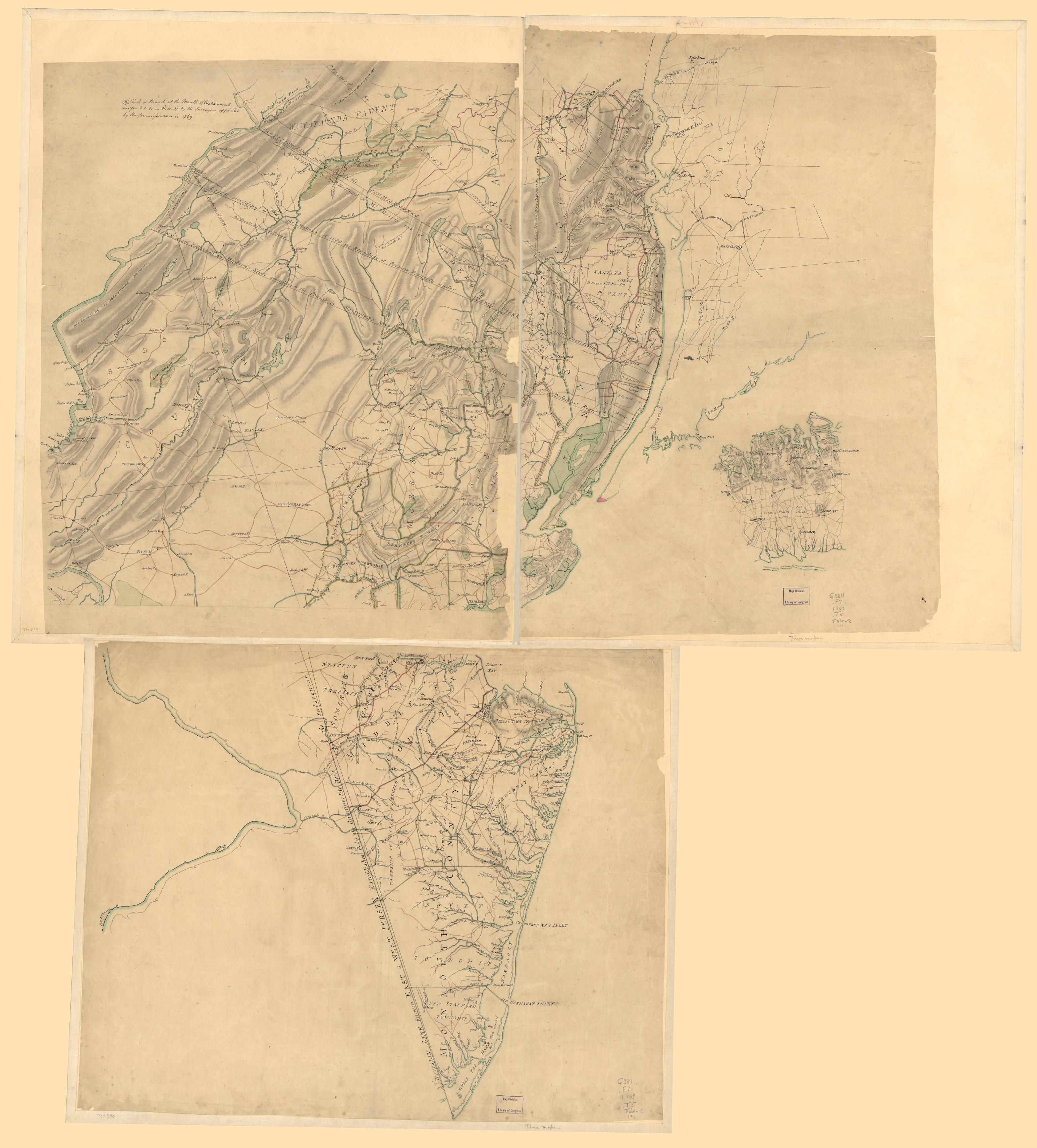

This substantial tract of approximately 2,260 acres in present-day Bergen County, New Jersey, encompassing parts of what are now Englewood, Teaneck, and Ridgefield Park, was granted to Sara Kierstede by Oratam, Sachem of the Hackensack Indians, with whom she had established a close working relationship.
The patent identified her as the widow of Hans Kierstede, formerly of New York. The grant comprised a neck of land between the Hackensack River and Overpeck Creek, as described in the June 24, 1669, patent issued by Governor Philip Carteret:
1669 June 24. Patent. Govr Carterett to Mrs. Sarah Kersted [sic], widow of Hans Kiersteden [sic], late of New York, Girurgion [sic; i.e. Chirurgeon], for a neck of land, given to her by Oratan [sic], the Sachem of Hackensack, and lying between the Hackensack River and Overpecks Creek, 2260 acres. (1)
This land grant is of particular interest because it identifies Sara herself, rather than her husband or another male relative, as the recipient and landholder, and records that she received the land in recognition of her services as an interpreter for Indigenous communities. Its significance is further underscored by George Scott’s 1685 account in The Model Government of East Jersey, which describes Sara as holding a patent for a large tract of land given to her by an “old Indian Sachem” in recompense for her interpreting work, adding that several small families were already living there:
There is a large neck or Tract of Land, for which one Mrs. Sarah Kirk-stead [sic], of New-York hath a Patent, given here by an old Indian Sachem, in recompence for her Interpreting the Indian Language into Dutch, as there was occasion; there are some little Families thereon. (2)
Sara received additional land in Manhattan on October 14, 1673, when Governor Anthony Colve issued a land patent to her husband, Cornelis van Borsum, also in recognition of her services in negotiations with Indigenous communities. The grant was located near the former windmill of New Amsterdam, on land that subsequently became the site of the African Burial Ground. (3)
Sara’s daughter, Blandina Kierstede Bayard, later acquired land at Ramapo from Indigenous owners as well, as this Agreement for the Purchase of Indian Lands dated October 5, 1697, indicates. (4) These land transactions are significant examples of women’s participation in landholding in 17th- century New Netherland.
Notes:
1) William Nelson, ed., Calendar of Records in the Office of the Secretary of State, 1664–1703, New Jersey Archives, First Series, vol. XXI (1899), citation p. 8, patent 58. A separate July 30, 1669, patent to Robert Vauquellin describing his 2,000 acres as “bounded on the south by Sarah Kierstede’s land,” confirms her tract existed by then.
In Teaneck Public Library Online, A Piece of Land Becomes a Town (October 21, 1970), Supplement, p. 7, reports that the Kierstede grant encompassed 2,120 acres, rather than the 2,260 acres specified in the original patent. The tract lay between the Hackensack River and Overpeck Creek, within the area of present-day Teaneck, New Jersey. For a detailed description of the land, consisting of woods, pastures, fields, meadows, pools, ponds, islands, creeks, and rivers, see The History of Teaneck Creek Conservancy.
2) George Scott, The Model Government of the Province of East-New-Jersey in America), Edinburgh, 1685, p 138. Scott's contemporary account describes Sara's patent as a large tract given by an Indigenous sachem and notes that families lived there. Scott's 1685 account is especially valuable because it provides near-contemporary corroboration of the reason for the grant and confirms that the property was already inhabited.
3) The African Burial Ground stands as the oldest and largest known excavated burial site in North America for both free and enslaved Africans, see African Burial Ground in History - African Burial Ground National Monument (U.S. National Park Service)
4) Auction Catalogue, Autograph Letters and Historical Documents. Philadelphia, December 6, 1909. Indians of New York. D. S. - Agreement of Blandina Bayard for ye land of Ramapogh, 5th Oct. 1697. In Dutch. Signed by Seven Indians with their marks or totems —The consideration includes various articles of use and clothing, a barrel of "seyter," &c. This is an agreement for the purchase of land at Ramapo, Rockland County (New York) with the following Native Americans: Zerickham, Mettissiena, Eghkenem, Onarkommagh, Kraghkon, Saeuwapigh Kim, and Nanawaron.
Further Reading:
Waltraud Kolb and Sonja Pöllabauer, Women as Interpreters in Colonial New Netherland: A Microhistorical Study of Sara Kierstede, in Introducing New Hypertexts on Interpreting (Studies) (John Benjamins, 2023), pp. 126–146.
Further information about the Map - Library of Congress:
Other Title: Three maps of northern New Jersey, with reference to the boundary between New York and New Jersey