

courtesy Wikipedia commons, public domain
Hi-Res: https://upload.wikimedia.org/wikipedia/commons/9/94/Surgeon01.jpg

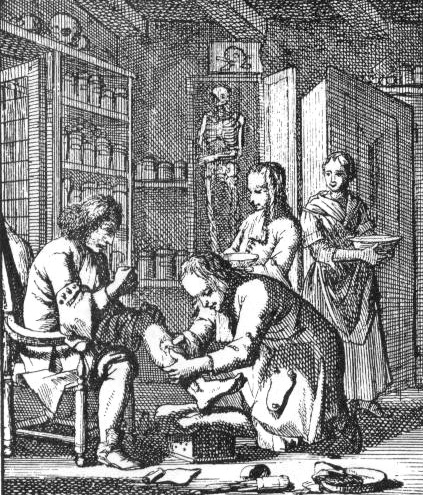
A print made by Jan Luyken dated ca. 1690, shows a barber-surgeon at work in his apothecary shop, tending to a patient seated before him. The practice room is outfitted with the tools and paraphernalia of his trade: a few surgical instruments, a bloodletting bowl held by an apprentice, bandages draped over a nearby stool, a human skeleton hanging in the corner as a teaching aid. Shelves filled with jars holding dried herbs and medicinal ointments line the walls.
In the Dutch colony, barber-surgeons or apothecaries –such as Hans Kierstede and his son-apprentice Roelof in their Apothecary in Pearl Street– provided much-needed medical care, though their numbers were few. Governor Peter Stuyvesant repeatedly urged the arrival of more trained physicians for the fledgling settlement, underscoring the essential role these practitioners played in colonial life.
Reference: This print is part of a series of etchings made by Jan Luyken and his son Caspar, illustrating human trades and occupations, published as Mirrror of Human Trades, or The Book of Trades in Amsterdam, 1694. Spiegel van het Menselyk Bedryf is the original Dutch title of this popular emblem book that features 100 engravings of traditional occupations accompanied by moralistic poems. For further reading see here
Artist: Jan [Johannes] Luyken, Dutch printmaker and poet (Amsterdam 1649-1712)
Date: ca. 1690