

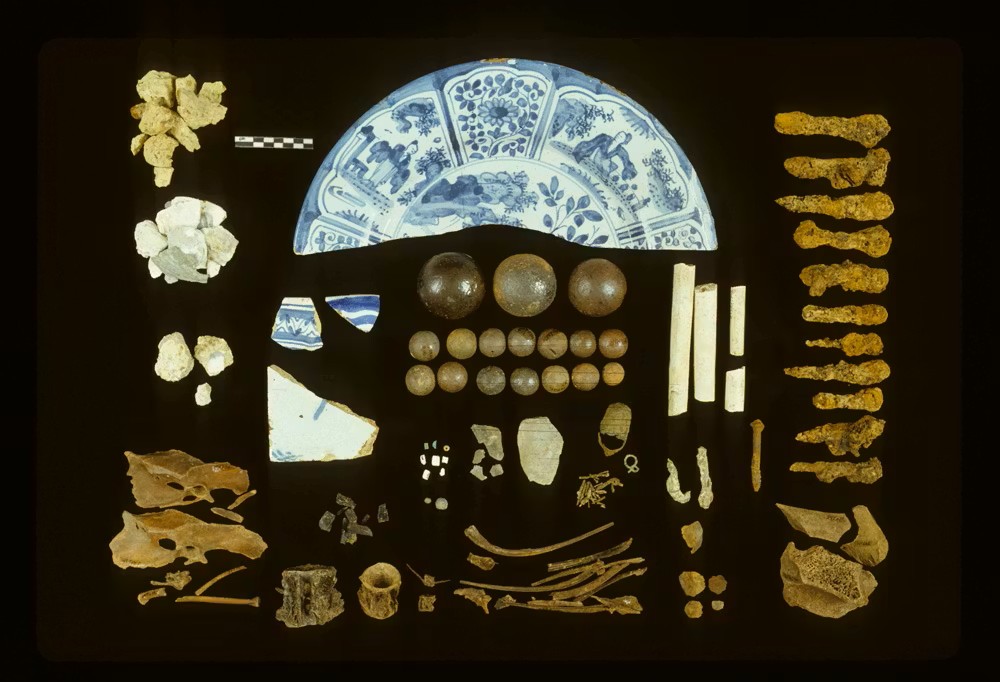
Courtesy of the New York State Museum, Albany, NY. Unidentified maker, ca. 1660. Scales, bones, teeth, wood fragments, stoneware, marbles, brick fragments, tile fragments, Kaolin clay pipe bowl and stem fragments, brown-glazed redware, glass fragments, nails, thimble, pin, shot, oyster shell, wampum, plate fragments.
Most surviving artifacts from New Amsterdam relate to European settlers, but in 1984, archaeologists found a collection of objects outside of the home of Cornelis Van Tienhoven, Peter Stuyvesant’s secretary, on present-day Pearl Street: a mpungu thought to be created circa 1660 by an enslaved person. Mpungu means “to stick together” and refers to a gathering of objects that in central African culture were invested with healing powers. This collection, featuring bone and shell fragments, marbles, nails, pieces of pipe stems and bowls, glass beads, a copper thimble, and other items, was found in a basket buried in the ground, covered with a Dutch plate. It is an example of how Africans in New Amsterdam sustained their cultural practices in the face of adversity.
The Mpungu was displayed at the New-York Historical Society's 2024 exhibit New York Before New York: The Castello Plan
Many of the enslaved Africans came from the Kingdom of Kongo, and their religious beliefs came with them.
Additional reading: https://en.wikipedia.org/wiki/Nzambi_a_Mpungu ; https://en.wikipedia.org/wiki/Kongo_religion